A Step-by-Step Bedtime Incense Routine for Better Sleep
Falling asleep shouldn't feel like a project. Yet here you are, at 11:47 p.m., scrolling, worrying, and wondering why your body refuses to follow your brain into rest. The lights are low. The phone is on silent. And still—nothing.
So what if the missing piece is the smallest, oldest one of all?
Not a pill. Not an app. Not some complicated breathing technique you'll forget by night three. A ritual. A few minutes of warmth, smoke, and intention that tells your nervous system, plainly and repeatedly: It is time to stop.
Here is the truth about sleep. It is not a switch you flip. It is a signal you send. And the most reliable signal you can send your body each night is a bedtime incense routine you actually repeat.

Why incense works at night
You don't just smell incense. You experience it.
Scent travels straight to the limbic system—the part of your brain that runs emotion, memory, and that low hum of alertness you can't seem to switch off. When you light the same calming stick, at the same hour, in the same dim room, every single night, something quietly rewires. Your brain learns the association. Smoke rises. Shoulders drop. The day loosens its grip.
This is the whole secret: consistency over intensity.
Step 1 — Prepare the space before you light anything
The ritual begins before the flame. Rushing to light a stick while standing in a messy, bright room defeats the point.
First, dim the lights. Then, clear your bedside table of anything that screams "work": laptops, charging cables, tomorrow's to-do list. Open a window for sixty seconds to give the room fresh air, then close it to trap the warmth. Sit down. Breathe once, deeply. Only now do you reach for the incense.
Step 2 — Choose the right scent for the hour
Not every calming scent belongs at bedtime. The goal here is not alertness, and it is not stimulation. It is emotional safety.
- Lavender → soft floral → the classic signal of rest. Gentle, familiar, unwavering.
- Sandalwood → warm, creamy wood → grounds you without waking you.
- Chamomile or soft rose blends → sweet, powdery → wraps the room in a blanket of calm.
Steer clear of anything bright, citrusy, or herbal-green at this hour. No matter how "energizing" it promises to be, energizing is the last thing you want.
Step 3 — Light it the mindful way
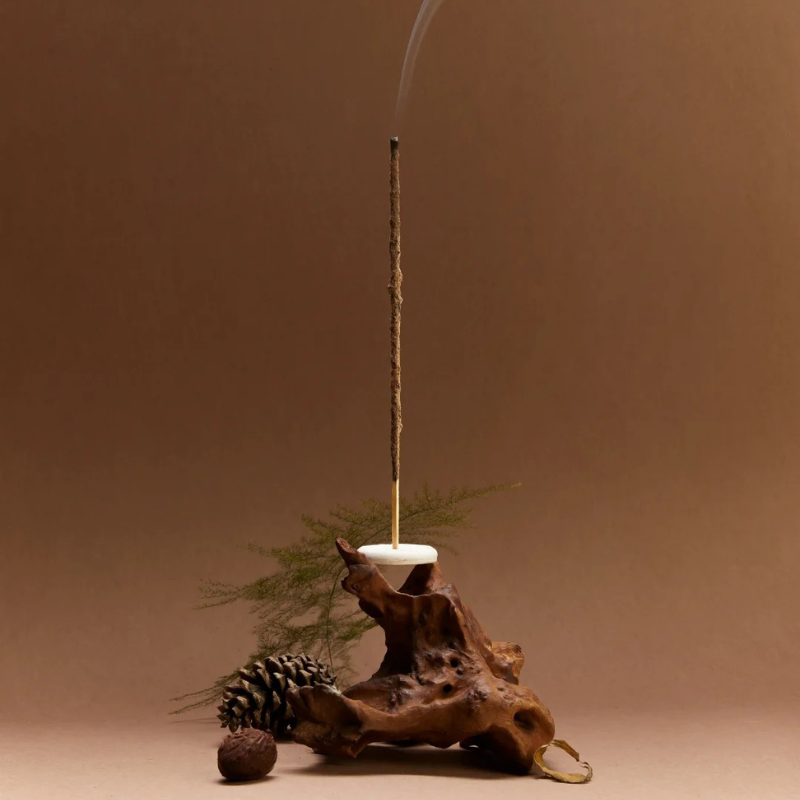
Hold the stick at an angle. Light the tip. Let the flame catch for a few seconds, then blow it out gently — letting the ember glow and the first thread of smoke rise.
Now, pause. Watch it. For one full breath, do nothing but follow that smoke with your eyes as it curls upward. This micro-moment of presence is where the magic lives. It is not dramatic. It is not fast. It is quiet, and that quiet is precisely the point.

Step 4 — Set the smoke in motion
Some people let the stick rest in a holder and simply breathe. Others find it more calming to walk the smoke slowly around the room — across the pillow, along the foot of the bed — as if tucking the space in for sleep.
There is no wrong method. The only requirement is that you move with intention, not speed. Slow hands. Soft breath. The smoke does not hurry, and neither should you.
Step 5 — Extinguish and settle in
After five to ten minutes, the room will carry enough. Don't leave the stick burning at your bedside all night—smoke thickens, and a sealed room needs to breathe. Press the ember into the holder, give it a final gentle wave to drift the remaining scent across the bed, and climb in.
Here is the part most people skip: lie still for two minutes and just receive the scent. No phone. No book. Just the room, the lingering smoke, and the slow unclenching of your jaw, your shoulders, your quiet breath.
Why the routine matters more than the scent
Let's be honest with ourselves. On night one, lavender incense probably won't knock you out any faster than plain darkness. But that's not how rituals work. They compound.
Every night you repeat this sequence, you are teaching yourself a language: smoke in the dark equals safety equals sleep. After a week, your body starts the wind-down the moment you dim the lights. After a month, it's automatic. You have outsourced the struggle to a habit—and habits, unlike willpower, don't run out at midnight.
Common mistakes to avoid
- Switching scents every night. Your brain can't build an association to a different signal each evening. Choose one bedtime scent and stick with it for at least two weeks.
- Using energizing scents at night. Citrus and mint are wonderful—at sunrise. At 11 p.m. they work against you.
- Burning too much. A little smoke signals calm. A room thick with smoke signals stay awake and cough. Less is more.
- An irregular hour. Lighting incense at 10 p.m. one night and 1 a.m. the next teaches your body nothing. Anchor it to a specific time.
- Doing it mindlessly. Light, drop, scroll. If your hands are on the phone while the smoke rises, you've missed the entire point.

The simplest way to begin
Don't overcomplicate your first week.
- Nights 1–3: Choose one calming scent. Light it, watch the smoke for one breath, then go about a normal, screen-free wind-down.
- Nights 4–7: Add the walk-around-the-room step. Move slowly. Breathe with the smoke.
- Nights 8 onward: Extinguish your incense, climb in, and take two silent minutes to receive the scent before you reach for anything.
That's it. Seven days. One scent. One habit.
At the end, it was never really about the incense. It was about giving yourself permission to stop—to mark the boundary between a day that demanded everything and a night that asks for nothing. The smoke rises, drifts, and fades. And somewhere in that fading, you remember how to let go.
So tonight, dim the light. Light the stick. And let the quiet do what pills never could: carry you home to sleep.